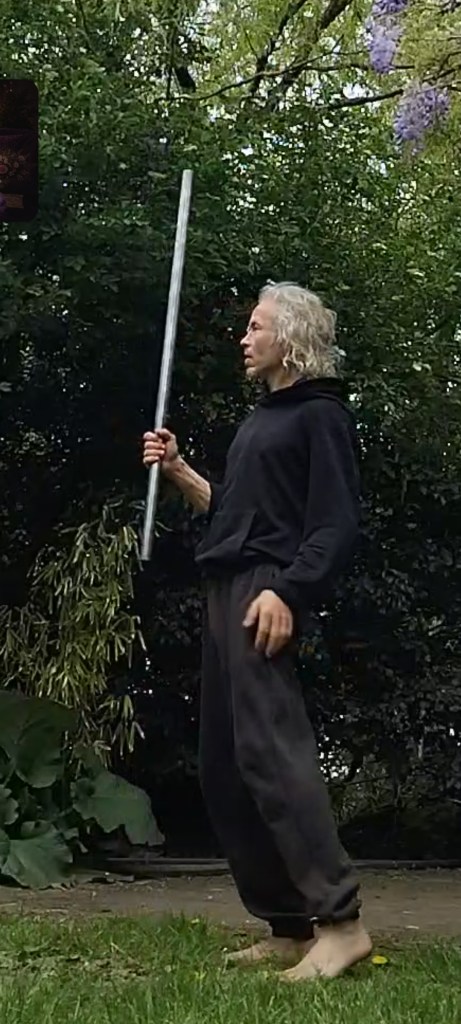
An embodied physics of movement through speed, amplitude, and distance.


See a short video on youtube: DANCE ON THE EDGE OF SILENCE

For questions, comments, and / or enquiries regarding presented activities please contact me via contact form below:

← Back

Thank you for your response. ✨

EXCLUSIVE ENTERTAINMENT PROGRAMME

A video recording on YouTube: Performance training with an object (2.88 kilogram steel tube)

  • Explosive power (speed > load)
  • Movement mechanics
  • Core stability
  • Shoulder control
  • Coordination under motion

Artistic Statement / Manifesto

I work within movement as a field of relationships rather than a sequence of steps. My practice is rooted in the continuous act of balancing and rebalancing the body through the dynamic interplay of speed, amplitude, and distance.

Speed is not only velocity, but sensitivity to time—acceleration, suspension, and interruption. Amplitude is not only size, but the elasticity between expansion and contraction. Distance is not only space, but intention—the shifting proximity between body, object, and environment.

Through these elements, movement becomes a living system. Each action generates a response; each imbalance produces a new form of harmony. I do not aim for stability, but for adaptability—an ongoing negotiation between control and release.

Objects are not props, but collaborators. They alter weight, redirect force, and reorganize perception. They extend the body beyond itself and challenge its habitual patterns.

My work invites the body into a state of heightened awareness, where motion is continuously recalibrated. In this space, dance is not performed—it emerges, as a consequence of attention, relation, and transformation.

Structured Training Method

Think of this as a repeatable session framework (60–90 minutes):

Phase 1:

Calibration (10–15 min)

Goal: awaken awareness of the 3 variables

Slow shifting of weight

Gradually increase/decrease speed Expand/contract movement range

Travel short ↔ long distances

👉 Focus: noticing transitions, not positions

Phase 2:

Isolation of Variables (15–20 min)

Train each element independently:

Speed-only

Same movement, different tempos

Amplitude-only

Micro ↔ maximal versions of same gesture

Distance-only

Same phrase, different spatial pathways

👉 Focus: control and clarity

Phase 3:

Interconnection (20–30 min)

Now combine variables:

Fast + small + near

Slow + large + far

Irregular combinations

Introduce instability:

Sudden stops

Direction changes

Uneven rhythm

👉 Focus: continuous rebalancing

Phase 4:

Object Integration (15–20 min)

Use an object (ball, stick, fabric, weight):

Let it lead movement

Let it resist movement

Let it disrupt rhythm

👉 Focus: object as partner, not tool

Phase 5:

Improvisational System (10–15 min)

Set rules:

Change one variable every 10 seconds

Respond to imbalance instead of correcting it

Let failure generate new pathways

👉 Focus: emergence

Movement Exercises

Exercise 1:

The Elastic Scale

Start with minimal movement

Gradually increase amplitude to maximum

Return to minimal

Add:

Variable speed

Changing direction

👉 Builds control over expansion/contraction

Exercise 2:

Broken Rhythm Flow

Move continuously

Interrupt yourself unpredictably

Restart with a different speed/amplitude

👉 Trains adaptability and rebalancing

Exercise 3:

Distance Mapping

Mark 3 imaginary points in space

Move between them:

Direct

Indirect

Interrupted

👉 Explores spatial intention

Exercise 4:

Object Resistance

Hold or interact with an object

Let it:

Slow you down

Pull you off balance

Change your trajectory

👉 Develops responsiveness

Exercise 5:

The Rebalance Loop

Intentionally lose balance

Catch yourself in a new position

Continue from there

Rule: never reset

👉 Turns instability into material